Soil Compaction Fixes for Bloomington MN Clay Lawns
If your Bloomington lawn drains poorly after rain, develops bare patches that resist reseeding, or stays spongy and then rock-hard depending on the season, compacted clay soil is almost certainly the cause. Hennepin County's glacially deposited clay soils are dense by nature, and decades of foot traffic, heavy equipment, freeze-thaw cycles, and even routine mowing press soil particles together until air, water, and roots have nowhere to go. The good news is that compaction is fixable — if you match the remedy to what clay soil actually does in a Minnesota climate.
Why Bloomington Clay Soils Compact So Readily
Clay particles are flat and plate-like, which means they stack tightly and expel pore space under pressure far more readily than sandy or loamy soils. In Bloomington and across Hennepin County, lawns sit on top of heavy glacial till that can hold moisture for days after rainfall. That sustained wetness makes clay especially vulnerable to compaction: when soil is saturated, particles slide against each other under load and lock into a denser arrangement as the soil dries. Repeated freeze-thaw cycles through a Minnesota winter compound the problem by expanding and contracting soil structure, often pushing the upper layer into a near-impermeable crust by spring.
The result is a lawn that sheds water instead of absorbing it, develops surface runoff channels, and supports grass plants with shallow, stressed root systems. Turf in this condition is also more susceptible to grub feeding damage and summer heat stress — two challenges already common in the Twin Cities metro.
Core Aeration as the Primary Compaction Fix
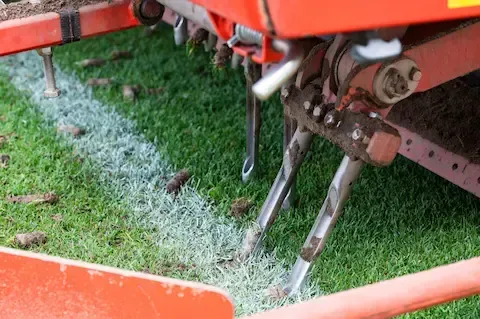
Mechanical core aeration is the most effective starting point for clay compaction in Bloomington. A core aerator pulls hollow plugs of soil — typically three to four inches deep — out of the lawn at regular intervals. This does three things simultaneously: it relieves mechanical pressure, it opens channels for air and water infiltration, and it creates physical pathways that roots can follow downward instead of spreading sideways near the surface.
For clay lawns, single-pass aeration is often insufficient. A double-pass pattern, run perpendicular across the lawn, creates nearly twice the number of holes per square foot and makes a measurable difference in both drainage speed and root depth by midsummer. Lawn aeration performed in late August through early October gives Bloomington clay lawns time to absorb fall moisture before the ground freezes, and it takes advantage of natural soil swelling during the first freeze-thaw cycle to widen the channels left behind.
Leave the pulled cores on the surface. They break down within a couple of weeks and return organic matter and soil microbes to the lawn — a small but meaningful contribution to improving clay structure over time.
Topdressing with Compost to Break Up Clay Structure
Aeration opens channels, but topdressing fills those channels with something better than what was there before. Applying a half-inch layer of finished compost across the lawn immediately after aeration allows organic material to work directly into the plug holes rather than sitting on top of a sealed surface.
In clay-heavy lawns, compost does something that sand cannot: it introduces humic acids and microbial activity that break chemical bonds between clay particles, a process called flocculation. Over multiple seasons, consistent topdressing gradually shifts clay from a tight, compacted matrix toward a more aggregated structure with stable pore spaces. A single application will not transform your lawn, but three to five seasons of aerating and topdressing will produce a measurable improvement in drainage and root development.
Avoid using pure sand as a topdressing amendment on Bloomington clay lawns. The common advice to "add sand to clay" is outdated and counterproductive: without adding sand in truly massive quantities — volumes impractical for residential lawns — the mix creates a mortar-like layer that compacts even more severely than the original clay.
Gypsum as a Soil Amendment for Heavy Clay
Gypsum (calcium sulfate) is one of the few granular amendments that can improve clay soil structure without altering soil pH. It works by introducing calcium ions that displace sodium and help clay particles clump into larger aggregates, improving drainage without the risks that come from adding lime to an already alkaline Hennepin County soil.
Apply gypsum at roughly 40 pounds per 1,000 square feet in fall, ideally just before or after core aeration so it reaches the soil profile rather than sitting on dense thatch. Results are gradual — expect six to twelve months before drainage improvement becomes noticeable — but gypsum is particularly well suited to Bloomington's clay soil chemistry and the Twin Cities' naturally higher-pH soil baseline.
When to Aerate and When to Wait
Timing matters more with clay than with other soil types. Aerating compacted clay when it is fully saturated — say, three days after a heavy rain — risks smearing the plug holes shut rather than opening them cleanly. Wait until soil is moist but not waterlogged. A hand-pressed soil plug should hold its shape without water seeping out.
Aerating during drought and heat is equally problematic. Dry clay becomes nearly concrete-hard, and aerator tines may fail to reach the required depth, leaving shallow holes that close quickly as the soil shifts. In Bloomington's climate, the optimal windows are mid-April through May for spring work, or late August through October for fall work — with fall being the preferred season for clay lawns because cooling soil temperatures and fall rainfall support the deepest and most sustained pore opening.
For lawns with severe compaction, consider scheduling aeration twice per year for the first two seasons. Once the soil structure begins to loosen, annual fall aeration is typically sufficient to maintain progress. You can build a full timeline for your specific lawn using the core aeration and overseeding roadmap that covers Bloomington's seasonal windows in detail.
Common Mistakes with Clay Lawn Compaction
Heavy equipment use on saturated clay is the fastest way to undo a season of improvement. Lawn tractors, rented aerators, and even overloaded wheelbarrows run on wet spring clay can compact the top six inches back to baseline in a single pass. Whenever possible, avoid driving or rolling heavy loads on Bloomington clay lawns between snowmelt and mid-May.
Overwatering is a second frequent mistake. Clay retains moisture longer than any other soil type, so irrigation schedules designed for sandy soils will keep clay lawns perpetually saturated. Adjust watering frequency rather than duration — longer, less frequent cycles give clay time to drain partially between waterings and reduce the cumulative compaction that comes from sustained saturation under foot traffic.
Finally, skipping overseeding after aeration wastes an opportunity. Compacted clay lawns typically have thin turf, and thicker grass cover is itself a compaction deterrent: root mass and organic decomposition from dense turf continuously introduce organic matter and microbial activity that fight compaction from the inside out.
Building Toward Better Soil Long-Term
Bloomington clay lawns will never behave like sandy loam, but they can be managed toward a structure that drains reliably, supports deep roots, and resists summer stress. The approach is straightforward: aerate aggressively in fall, topdress with compost, add gypsum seasonally, and protect the soil from heavy traffic during wet periods. None of these steps is complicated, and each reinforces the others over time.
A consistent three-to-five-year program of combined aeration, topdressing, and amendment typically transforms even severely compacted Hennepin County clay lawns into turf that holds up through Minnesota summers and recovers quickly from winter stress. The work is cumulative, and the earlier you start, the more progress your soil can make before the next growing season.

