Bloomington MN Core Aeration and Overseeding Roadmap
Bloomington lawns face a specific set of challenges that make core aeration and overseeding one of the most valuable maintenance cycles you can run each year. Between the heavy clay soils common throughout the Minnesota River valley corridor, the foot traffic from backyard recreation, and the freeze-thaw stress that compacts turf from October through April, grass plants in this region are fighting for air, water, and root space every season. A well-timed aeration and overseeding program addresses all three problems in a single coordinated effort — and when you do it right, the results carry your lawn through two or three growing seasons without major intervention.
Why Bloomington Soil Conditions Make Aeration Non-Negotiable
The soils across Bloomington and the broader Hennepin County area are heavily influenced by glacial till deposits. That translates to a high clay content in most residential lots, particularly in neighborhoods built before 1990 where original topsoil was often stripped during construction and never fully replaced. Clay particles pack tightly together under pressure, squeezing out the macro-pore spaces that turf roots depend on to exchange oxygen and absorb water. When you add a full Minnesota winter on top of that soil — with multiple freeze-thaw cycles running from November into March — the compaction problem compounds year after year.
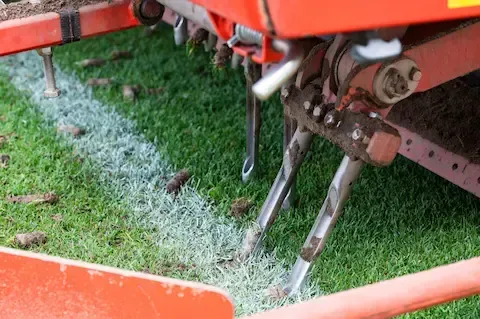
Core aeration mechanically breaks that cycle. A drum aerator pulls cylindrical plugs of soil roughly two to three inches deep and leaves them on the surface to break down. Each hole creates immediate relief for root expansion, improves drainage by connecting surface water to deeper soil layers, and generates micro-environments where overseeded grass can establish without competing against existing thatch. Without this physical intervention, overseeding is largely wasted — seed sitting on top of compacted turf has almost no chance of reaching viable germination depth.
Choosing the Right Timing Window for Zone 4b
Timing is where most Bloomington homeowners make their biggest mistakes, and it comes down to understanding how cool-season grasses respond to soil temperature. The Upper Midwest's Zone 4b classification means your last frost arrives in late April and your first fall frost typically lands between October 1 and October 15. That window matters enormously for overseeding success.
The ideal aeration and overseeding window in Bloomington runs from late August through the third week of September. You are targeting soil temperatures between 50 and 65 degrees Fahrenheit, which is warm enough for rapid germination but cool enough that new seedlings are not immediately stressed by summer heat. Seeding in this range also puts new grass plants through a full six to eight week establishment period before the first hard frost, which gives them time to develop root systems capable of surviving a Minnesota winter.
Late August — specifically the window from August 20 through September 10 — is the sweet spot most turf professionals recommend for Bloomington conditions. Soil holds enough warmth from summer, ambient temperatures drop into the 60s at night, and fall rainfall patterns become more reliable than the inconsistent August storms that can leave newly seeded areas dry for days at a stretch.
Spring aeration is a secondary option but carries real trade-offs. You can aerate in May after the ground fully thaws, which relieves compaction effectively. But overseeding in spring means competing with crabgrass and annual weed pressure, and it puts new grass through its first summer — the most stressful season — before the root system is fully established. Fall is almost always the better choice for overseeding in this climate.
Plug Spacing, Pass Patterns, and Equipment Settings
How you run the aerator matters as much as when. A single pass with a drum aerator typically pulls plugs at four to six inch intervals depending on machine settings and your walking pace. For heavily compacted Bloomington clay soils, a single pass is often insufficient. Two passes at perpendicular angles — one running north to south, the second running east to west — doubles your plug density and does a significantly better job breaking up the clay matrix. You should be pulling somewhere between 20 and 40 plugs per square foot across the treated area to see meaningful improvement in a compacted lawn.
Aerator tine depth matters too. Most consumer-grade rental machines pull tines to a depth of about two to two and a half inches. Professional equipment commonly reaches three inches or more, which is meaningfully better for accessing the compaction layer that forms at the top of undisturbed subsoil. If your lawn has not been aerated in three or more years, the investment in professional equipment often pays off in the first season through visibly better results.
Leave the plugs on the surface. Many homeowners try to rake or remove them, but those plugs contain beneficial organisms and organic matter that break back into the lawn within two to three weeks with normal watering. They also act as a natural top-dressing material that helps cover seed once you begin overseeding.
Seed Mix Selection for Bloomington Conditions
Not all grass seed performs equally in Zone 4b, and the wrong seed mix is a fast way to waste both money and effort. The standard recommendation for Bloomington residential lawns is a blend dominated by Kentucky bluegrass with a supporting mix of turf-type tall fescue and perennial ryegrass. Each species plays a specific role.
Kentucky bluegrass is the workhorse species for Minnesota lawns. It spreads through underground rhizomes, fills in thin spots over time, and tolerates the region's cold winters better than most alternatives. The trade-off is that bluegrass germinates slowly — typically 14 to 21 days under ideal conditions — and it requires higher fertility inputs to stay dense. Look for improved varieties like Midnight, Moonlight, or Barduke, which offer better disease resistance than older common-type bluegrass.
Turf-type tall fescue adds drought tolerance and performs well in the shadier areas that are common in Bloomington neighborhoods with mature tree canopies. It germinates in seven to ten days, which means it establishes faster than bluegrass and provides early ground cover that helps protect newly aerated soil from erosion and moisture loss.
Perennial ryegrass fills a transition role. It germinates in five to seven days, emerges quickly, and holds the seedbed while slower species catch up. For overseeding, a blend of roughly 50 percent Kentucky bluegrass, 30 percent turf-type tall fescue, and 20 percent perennial ryegrass performs consistently well across Bloomington's mix of sun and partial-shade conditions.
Seeding rate for overseeding into an existing lawn is typically three to four pounds of pure live seed per thousand square feet. For thin or bare areas, increase to six to eight pounds. Under-seeding is one of the most common mistakes — the instinct to stretch a bag of seed too far results in sparse germination and gaps that weeds quickly exploit.
Post-Aeration Fertility and Watering Protocol
Seeding without proper fertility support is a setup for poor establishment. Immediately after aerating and overseeding, apply a starter fertilizer with a high phosphorus ratio — something in the range of 18-24-12 or similar. Phosphorus drives root development in young seedlings, and new grass plants emerging in aerated holes need that support immediately. Avoid high-nitrogen fertilizers at seeding time because they push top growth at the expense of the root development you actually need heading into winter.
Watering protocol after overseeding is the most demanding part of the entire process and the piece most homeowners underestimate. For the first two weeks after seeding, the top half-inch of soil must stay consistently moist. That often means two light watering sessions per day — typically early morning and late afternoon — at roughly five to ten minutes per zone. The goal is moisture without saturation. Seed that dries out between germination and first root contact with the soil is lost seed.
Once you see consistent germination across the seeded area, shift to a deeper, less frequent watering schedule. Water deeply every two to three days, applying enough to penetrate the top two inches of soil. This trains root systems downward, building the drought tolerance that Bloomington lawns need to survive dry stretches in June and July.
For homeowners who are also monitoring for turf pests, watch for signs of stress in newly seeded areas that could indicate feeding damage below the surface. Understanding early grub damage signs during this period is important because grub activity in late summer overlaps directly with your overseeding window, and feeding pressure can destroy new seedlings before they establish.
First Mow and First-Season Management
New grass from overseeding should not be mowed until it reaches three to three and a half inches in height. Cutting too early pulls seedlings out of the soil before roots have anchored, and a dull blade makes the problem worse by tearing rather than cutting. Make sure your mower blade is sharp for the first few cuts on a newly overseeded lawn. Set the deck no lower than two and a half to three inches for the entire first season — taller mowing height reduces heat and drought stress on immature root systems.
Avoid pre-emergent herbicides in the fall of your overseeding year. Pre-emergents work by preventing seed germination, and they cannot distinguish between crabgrass seed and your newly applied turf seed. Hold off until your second fall season before re-introducing pre-emergent applications.
A well-executed late-August aeration and overseeding cycle in Bloomington will produce visible density improvement by mid-October of the same year, with full thickening evident by the following June. The process is not complicated, but the details — timing, seed rate, watering consistency — determine whether you get a lawn that carries for years or a scattered result that invites weeds and thin spots the following spring. Lawn aeration done at the right time with the right seed is the single highest-return maintenance investment you can make in a Zone 4b lawn.

