Late August Overseeding Window for Bloomington Lawns
The last week of August feels like summer is still running the show in Bloomington, but your lawn calendar tells a different story. Soil temperatures in Zone 4b typically hold between 65°F and 72°F during this window — exactly the sweet spot Kentucky bluegrass and tall fescue need to germinate quickly and build enough root mass before the first hard frost. Miss this window by even two weeks and you are racing against cooling nights, shorter days, and a frost-date math problem that tilts against young seedlings. Getting seed in the ground now, while conditions are working in your favor, is one of the highest-return decisions a Bloomington homeowner can make for the following spring.
Why Late August Is the Right Moment
Bloomington sits in USDA Hardiness Zone 4b, and local frost records place the first average frost around October 7th to October 14th. Cool-season grasses need a minimum of 45 to 60 days of active growth before they can survive a freeze. Count backward from October 10th and you land squarely in late August as your seeding deadline. Earlier is better — seed placed on August 22nd has roughly 49 days of frost-free growing time, while seed dropped on September 10th may have only 30 days before temperatures force dormancy on a still-fragile plant.
Soil warmth is the second factor. After a full summer of sun exposure, Bloomington's clay-loam soils retain heat well into the evening hours during August, which accelerates germination. Air temperatures begin cooling at night while the soil stays warm — a combination that drives root development without stressing the leaf blade. By mid-September that advantage fades quickly as soil temperatures drop below 60°F and germination slows to an unreliable crawl.
Seed Selection for Bloomington Yards
Not every grass variety performs equally in Bloomington's climate. Kentucky bluegrass remains the dominant choice for full-sun lawns here — it spreads by rhizome, fills in bare spots over time, and handles Minnesota winters without heaving damage. For shaded yards under the mature oaks and maples common in south Bloomington neighborhoods, a fine fescue blend tolerates lower light and drier soil conditions far better than bluegrass alone. Tall fescue adds drought resilience in high-traffic areas and performs well along the edges of Hyland Lake Park Reserve, where irrigation access is sometimes limited for adjacent residential lots.
Avoid annual ryegrass in any overseeding mix. It germinates fast and looks green quickly, which is tempting, but it will not survive a Zone 4b winter. Perennial ryegrass is an acceptable companion at low percentages for quick establishment, but the bulk of your mix should be species matched to your existing lawn type. Read the tag, not just the bag color.
Seed-to-Soil Contact Is Everything
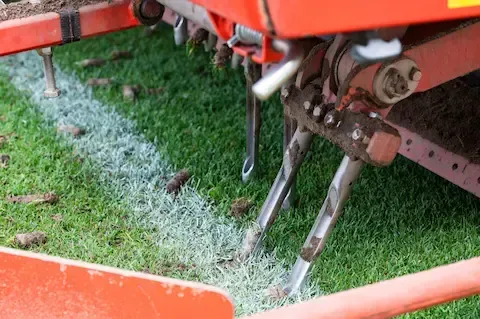
Overseeding on top of thick thatch accomplishes almost nothing. Seed that never touches mineral soil cannot germinate reliably, and you will end up with an uneven result that wastes both time and money. This is where Lawn aeration becomes the critical first step. Core aeration pulls plugs from the soil surface, opening channels that accept seed, hold moisture, and allow roots to penetrate without compaction resistance. In Bloomington's notoriously compacted soils — especially in newer subdivisions off American Boulevard and Penn Avenue where construction traffic once ran — aeration is not optional, it is foundational.
After aeration, overseed immediately or within 24 to 48 hours. Spread seed in two perpendicular passes to avoid striping. Use a rotary spreader calibrated to the rate listed on your seed tag, typically 3 to 5 pounds of pure live seed per 1,000 square feet for overseeding into an existing lawn. Lightly drag the area with the back of a rake or a slice seeder to ensure seed drops into the aeration holes and contacts the soil in between.
Watering Rules That Actually Work
New seed requires consistent surface moisture for germination, but that does not mean flooding. The top quarter inch of soil needs to stay damp — not saturated — until seedlings reach about one inch of height. In practice, this means two to three short watering cycles per day during dry weather, each running five to eight minutes depending on your sprinkler output. Early morning and early afternoon cycles work best. Avoid evening watering, which leaves moisture sitting on the soil surface overnight and can encourage fungal issues in Bloomington's late August humidity.
Once seedlings reach one inch, begin transitioning to deeper, less frequent watering. At two inches of height, shift to a standard mature-lawn schedule of one inch per week applied in two sessions. This transition encourages roots to chase moisture downward rather than staying shallow where they are vulnerable to temperature swings.
Common Mistakes That Cost Bloomington Homeowners
The most expensive mistake is skipping scalping before you seed. Mow your existing lawn down to 1.5 inches before overseeding so new seedlings are not competing for light under a canopy of tall grass. The second common mistake is applying starter fertilizer too aggressively — a phosphorus-rich starter at label rate is appropriate, but high nitrogen at seeding pushes excessive leaf growth in existing grass, which shades out your new seedlings before they establish.
Foot traffic on newly seeded areas is another recurring problem in yards with children or dogs. Flag off the seeded sections if possible and give the turf at least four mowings before treating it as fully established. The core aeration and overseeding roadmap covers the full multi-step sequencing in detail if you want a broader view of how each phase connects to the next.
Mowing New Seedlings Correctly
Wait until new grass reaches three inches before the first mow. Set your mower deck to two and a half inches and keep blades sharp — a dull blade tears rather than cuts, which stresses young plants that have not yet anchored firmly. Never remove more than one third of the blade height in a single pass. For Bloomington lawns going into October, you will typically get two to three mows on new seedlings before the season winds down, which is enough to establish good tillering and crown development heading into winter.
Reading the Season Before You Commit
Check the National Weather Service extended forecast for the Minneapolis-Saint Paul metro before you seed. If a heat dome is forecast to push daytime highs above 85°F for more than three consecutive days immediately after seeding, consider waiting until the event passes. Brief heat after seeding forces the soil surface to dry out faster than twice-daily watering can compensate. Bloomington typically sees its last significant heat events in mid-August, making the August 22nd to September 1st window the most reliable stretch of the late-season calendar for overseeding success in Zone 4b yards.

