Dandelion and Clover Control on Bloomington MN Lawns
Dandelions and clover are two of the most persistent broadleaf weeds in Bloomington, Minnesota lawns, and they thrive for different reasons. Dandelions exploit thin turf and compacted soil. Clover moves in when nitrogen levels drop. Both spread aggressively if you let them go to seed or let the underlying lawn conditions go unaddressed. The good news is that with the right herbicide choice, correct timing, and a clear-eyed look at your lawn's specific pressure, you can knock both out in a single season and keep them from returning.
Why Dandelions and Clover Take Over Bloomington Lawns
Bloomington sits in USDA Hardiness Zone 4b to 5a, which means cool-season grasses like Kentucky bluegrass and tall fescue dominate local lawns. These grasses grow vigorously in spring and fall but thin out under summer heat stress. That thinning is exactly what dandelions are waiting for. A single dandelion plant can produce up to 15,000 seeds in a season, and seeds blow in from neighboring yards constantly. Once the taproot reaches six inches deep, hand-pulling without a tool rarely removes the whole plant, and any fragment left behind regrows.
Clover tells a different story. It does not spread by wind the same way dandelions do. Instead, it creeps through stolons and seeds when mowing height is set too low or when your soil is deficient in nitrogen. Many homeowners in older Bloomington neighborhoods with clay-heavy soils see clover establish itself along edges and in low spots where water pools and turf thins out. Unlike dandelions, clover fixes its own nitrogen from the air, so a fertilizer-deficient lawn is an open invitation.
Choosing the Right Herbicide for Each Weed
Both weeds respond to selective postemergent broadleaf herbicides, but the active ingredient matters. Products containing a three-way mix of 2,4-D, MCPP (mecoprop), and dicamba are the standard for dandelion control and work reliably across Bloomington lawns. For clover, you need a formulation that includes triclopyr. Triclopyr is aggressive against clover's thick waxy leaves, which resist 2,4-D uptake. Many professional-grade products combine all four actives in a single formulation, making one application handle both weeds simultaneously.
Read the label carefully before any application. Minnesota has specific buffer requirements near water bodies, and Bloomington's location near Hyland Lake Park Reserve and the Minnesota River corridor means some properties have setback restrictions. If your yard backs up to a pond, drainage easement, or wetland edge, check local guidelines before applying any broadleaf herbicide to that area.
Timing Your Application in Minnesota
Spring is the highest-leverage window for dandelion control. Treat when dandelions are actively blooming — usually mid-April to mid-May in Bloomington — but before seed heads form. At this stage the plant is pushing energy up to the flower, leaves are fully expanded, and herbicide absorption is at its peak. Treating too early, when leaves are still small and emerging, reduces efficacy. Treating after the white seed clock forms is worse: you get partial control and help spread seeds across your lawn in the process.
Clover has a slightly longer treatment window. It responds well to late spring applications and again in early fall when the plant is still actively growing but temperatures have cooled below 85°F. Avoid applying any broadleaf herbicide during a heat wave. Above 85 degrees Fahrenheit, warm-season volatilization increases and cool-season turf can suffer herbicide stress, yellowing temporarily even when the product is applied correctly. For Bloomington lawns, the sweet spot is 60 to 80°F with no rain forecast for 24 hours after treatment.
Spot-Treating vs. Broadcast Application
One of the most practical decisions you will make is whether to spot-treat or broadcast-spray your lawn. Each approach makes sense in different situations, and the right call depends on how much of your lawn is affected.
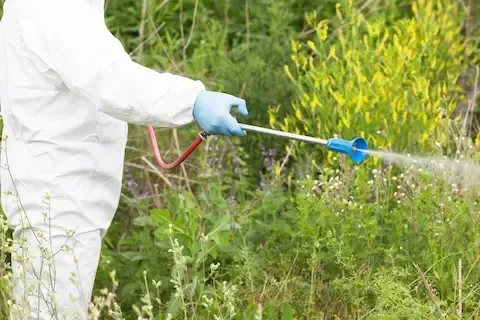
Spot-treat when weeds cover less than 25 to 30 percent of your total lawn area. A backpack or pump sprayer with a fan nozzle lets you target individual plants or clusters without exposing the entire lawn to herbicide. This is more economical, reduces chemical load, and is faster for scattered infestations.
Broadcast-spray when weeds are widespread and cover the majority of the turf. A broadcast application using a hose-end sprayer or professional boom sprayer is more efficient and gives more uniform coverage. If more than a third of your lawn shows weed pressure, spot-treating takes too long and misses plants you do not see yet.
Consider a hybrid approach for mixed lawns, where one area has heavy clover pressure and another has scattered dandelions. Broadcast the heavily infested zone and spot-treat the rest.
If you want professional results without managing the product selection and timing yourself, weed control through a local lawn care provider takes the guesswork out of the process, especially for properties with complex weed pressure or setback restrictions near water.
Lawn Health Is Your Long-Term Defense
Herbicide gets rid of the weeds you have. A healthy lawn prevents the next wave. Dandelions and clover fill bare ground and thin turf. The most effective long-term strategy combines chemical control with cultural practices that restore turf density.
Mow at 3 to 3.5 inches. Bloomington's clay soils retain moisture well, but higher mowing heights shade the soil surface, reduce weed seed germination, and let cool-season grass roots grow deeper. Overseed thin areas in early September when soil temperatures are still warm enough for germination but air temperatures favor cool-season grass establishment. Core aerate every one to two years to address compaction, which is a root cause of dandelion pressure in older residential neighborhoods throughout Bloomington.
Nitrogen management directly suppresses clover. A properly timed fertilization schedule — one that delivers adequate nitrogen in spring and again in fall — maintains the turf density that pushes clover out naturally. For a broader look at integrating these efforts across the season, the fertilizer and weed control master plan walks through how Bloomington homeowners can sequence these applications for maximum impact.
What to Expect After Treatment
After a correctly timed broadleaf herbicide application, dandelions typically show visible wilting and leaf curl within three to seven days. Full browning takes ten to fourteen days. Clover may take slightly longer, particularly on thick mats. Do not mow for two to three days before treatment and 48 hours after, so leaves retain maximum surface area for absorption. If rain arrives within 24 hours of application, you will likely need to retreat. One treatment handles most infestations, but heavy pressure sometimes requires a second application four to six weeks later.

